
The Ultimate Guide to Japan Motorcycle Tours 2026: Riding the Japanese Alps
If you’ve spent your life chasing the perfect line through the Pyrenees or the Rockies, you know the feeling: that moment when the bike, the road, and your lizard brain sync up at 60 degrees of lean. You don’t ride to “see things”; you ride to feel the mechanical sympathy of a well-timed downshift and the lateral G-forces of a perfectly executed apex.
But let’s be real. Most “international motorcycle tours” are designed for the lowest common denominator. They keep you on the highways, they park you in tourist traps, and they treat your Yamaha Tracer 9GT+ like a mobility scooter.
At ADVpaths, we built the Japan Craft, Culture & Riding Journey for the rider who actually likes to ride. This isn’t a sightseeing holiday; it is a technical expedition into the heart of a 70% mountainous archipelago designed by the gods for sport-touring.
1. The Asphalt: Japan’s Secret Engineering Weapon
You haven’t truly lived until you’ve experienced Japanese mountain asphalt. It’s not just “road”; it’s a high-friction, impeccably maintained surface engineered with a level of precision that makes the Stelvio Pass look like a gravel driveway.
The Physics of the Grip
In the Japanese Alps, the aggregate in the bitumen is chosen for its drainage properties during the “Tsuyu” (rainy season). For the rider, this means predictability. When you’re trail-braking into a blind hair-pin on the outskirts of Takayama, you aren’t hunting for potholes or mid-corner gravel. You are trusting a consistent contact patch.
The “Venus Line” Masterclass
On Days 4 and 5, we hit the Venus Line and the Nagano Highlands. These aren’t just “scenic routes.” They are technical, rhythmic masterpieces of civil engineering.
The Sweepers: We’re talking about constant-radius sweepers that let you settle into a deep, stable lean for 5–10 seconds at a time.
The Switchbacks: Tight, uphill hairpins that demand proper rear-brake dragging and vision techniques. If you aren’t looking 50 meters ahead at the exit, the mountain will remind you quickly.
2. The Fleet: Precision, Not Compromise
We know you have a “real” bike at home. You likely have a dialed-in suspension and a favorite set of tires. That’s why our 2026 fleet isn’t an afterthought. We choose bikes that complement the Japanese terrain—which is tight, twisty, and demands agility over raw horsepower.
The Weapons of Choice:
The Neo-Classic: Kawasaki Z900RS. This is for the purist. Want to feel the inline-four scream through a tunnel in the Japanese Alps? The Z900RS offers that raw, mechanical connection. Its upright geometry is surprisingly capable when you need to flick it through the “S-curves” of the Hokuriku region.
The Tech-Tourer: Yamaha Tracer 9GT+. Equipped with semi-active suspension and adaptive cruise control, this is the ultimate weapon for 200km+ days. The CP3 engine has the torque to pull you out of tight mountain corners without dancing on the gear lever.
The Line-Hunter: Honda NC750X DCT. Don’t scoff at the DCT. In the most technical sections of the Nagano passes, where you’re shifting 40 times in three minutes, the DCT allows you to focus 100% on your body position and your apex. It’s a “cheat code” for mountain riding.
3. The “Takumi” Connection: Mechanical Empathy
As experienced riders, we appreciate craftsmanship—the click of a precise gearbox, the feel of a forged frame. This tour bridges that mechanical appreciation with Japan’s living history.
When we stop in Seki, we aren’t just looking at knives in a gift shop. We are visiting the workshops of the Takumi—masters of steel whose ancestors forged the katanas of the Samurai. The dedication they show to a blade’s edge is the same dedication we bring to maintaining our fleet.
Why “Culture” Matters to a Rider
Riding in Japan is a lesson in Zen and the Art of Motorcycle Maintenance. The discipline of the local drivers and the cleanliness of the rest stops (Michi-no-Eki) create a low-stress environment. This “mental bandwidth” is then free to be spent on the road itself.
4. Decoding the Logistics: The ADVpaths Difference
We get it. You hate being stuck in a 20-bike “follow-the-leader” convoy. It’s boring, it’s slow, and it’s dangerous.
Small Groups, High Velocity
Our groups are capped to ensure we can move through the mountains as a cohesive unit. Our guides don’t just “lead”—they act as your local fixers.
ETC & Tolls: Japan’s toll system is a nightmare for foreigners. We handle all the electronic toll collection (ETC) so you never have to faff with gloves and coins at a booth.
The Support Van: Your luggage travels separately. This is crucial. A bike handles differently when it’s not lugging 30kg of panniers. We want you on a naked, light machine so you can actually feel the suspension working.
5. Technical Terrain Analysis: What to Expect
To truly understand Japan, you have to understand the physics of the Alps.
Elevation Changes
You will be climbing from sea level to over 2,000 meters in a single afternoon. This means temperature drops and potential fog. Your gear needs to be versatile. We recommend a high-end 3-layer Gore-Tex system.
Vision and Shadows
The forests in the Alps are dense. In the afternoon, the “strobe light” effect of sun through the trees can be disorienting. A high-quality helmet with a drop-down sun visor or a photochromic shield is a safety requirement.
The Coastal Transition
When we move from the mountains to Nishi Izu, the road changes. The asphalt becomes salt-aired and wind-swept. The curves become longer, faster “sweepers” overlooking the Pacific. It requires a shift in riding style—moving from the “point-and-shoot” mountain style to a more fluid, high-speed flow.
6. ATGATT in Japan: Professional Standards
Japan has a very high standard of riding gear. You will see local riders in full Dainese or Alpinestars leathers even on a Sunday coffee run. At ADVpaths, we mandate ATGATT (All The Gear, All The Time).
The Kit List for 2026:
Armor: Level 2 CE protection is the minimum.
Boots: Full-height touring boots. The mountain roads have steep inclines; you need the ankle support when stopping on uneven surfaces.
Connectivity: We use mesh communication systems. Whether it’s a warning about a patch of damp road in a tunnel or a quick “check the view,” staying connected enhances the experience.
7. The Rider’s Intel: Frequently Asked Questions
When you’re preparing for a 2,000km expedition through the Japanese Alps, the details matter.
The Paperwork: The International Driving Permit (IDP)
This is the single most important piece of gear you will pack. Japan is extremely strict about licensing.
The Convention: You specifically need an IDP issued under the 1949 Geneva Convention. Many countries issue multiple versions. If yours says “1968 Convention,” the rental agency legally cannot give you the keys. Ensure your motorcycle endorsement is clearly marked.
Onsen Etiquette: Tattoos and Tradition
After a 300km day of technical mountain riding, nothing beats a soak in a natural volcanic hot spring (Onsen).
The Tattoo Rule: Historically, tattoos were associated with organized crime. While modern Japan is much more relaxed, some traditional Ryokans still have “no tattoo” policies in public baths.
The ADVpaths Solution: We specifically scout tattoo-friendly Onsens or Ryokans that offer Kashikiri (private family baths) so you can soak in privacy overlooking the mountains.
The “Michi-no-Eki” Phenomenon
Forget the depressing petrol stations of the West. Japan has Michi-no-Eki (Road Stations).
Why Riders Love Them: They are strategically located at the start or end of the best mountain passes. They offer high-octane fuel, pristine restrooms, and gourmet local food. You haven’t lived until you’ve had a handmade Soba bowl in the middle of a mountain range.
The Community: On weekends, these stations become “Bike Meets.” You’ll see pristine 1980s 2-strokes and the latest superbikes. It’s a chance to see Japan’s obsessive bike culture up close.
Technical Comparison: Which Weapon for the Alps?
We run our tours during the two “Goldilocks” windows of the Japanese year.
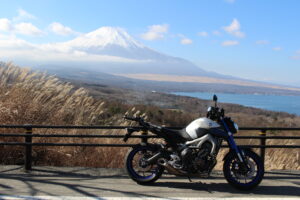
The Spring (May): The “Snow Walls” are still visible on the high passes, the air is crisp, and the greenery is vibrant. It’s perfect for the rider who wants cool, dense air for the engine and clear views of Mt. Fuji.
The Autumn (October): This is the season of Koyo (Autumn leaves). The mountains turn fire-red and deep orange. The grip is still excellent, and the humidity of summer has vanished. It is arguably the most beautiful time to be on a bike in the Northern Hemisphere.
8. Final Thoughts: The ROI of Adventure
A 12-day tour in Japan isn’t just a line item in a budget; it’s an investment in your riding resume. When you return home, you won’t remember the emails you missed.
You will remember the smell of cedar trees in the Nagano forest. You will remember the specific “thump-thump” of the Honda engine as you crested the final ridge of the Izu Skyline. And you will remember the feeling of absolute precision that only Japanese asphalt can provide.
The Alps are waiting. The Takumi have finished the steel. The only missing element is you in the saddle.
Are you ready to redefine what a motorcycle tour can be?